
The Best Tech Setup Behind Good Telehealth
.png)
Telehealth is often framed as simple. A video link, a conversation, a prescription. Compared to the infrastructure of traditional medicine, it can seem almost frictionless.
But that simplicity is deceptive.
As telehealth becomes embedded in everyday clinical practice — whether delivered from a clinic, a dedicated telehealth hub, or a home workspace — a more nuanced reality is emerging. The quality of care is not defined by the technology alone, but by the environment that surrounds it. In telehealth, your setup is your consulting room.
And like any consulting room, it needs to be designed with intent.
The first priority is clarity — both visual and auditory.
Without the ability to examine a patient physically, clinicians rely heavily on what they can see and hear. Subtle clinical cues — facial expression, speech pattern, respiratory effort — become central to assessment. A poor camera or inconsistent lighting can obscure these signals, but it is often audio that becomes the limiting factor. Built-in laptop microphones frequently struggle with background noise and variable volume, leading to missed details and repeated questioning.
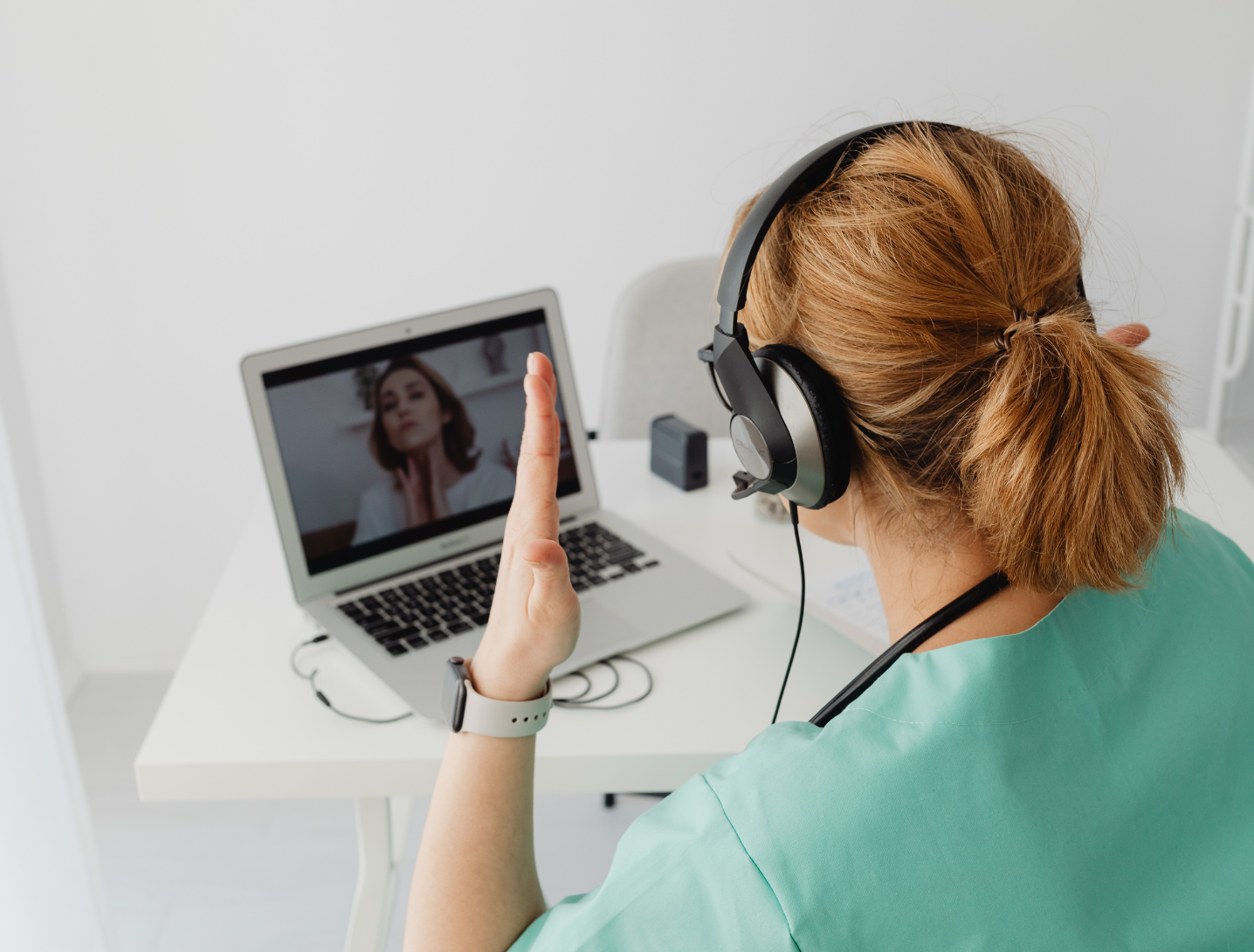
A high-quality headset with both clear audio output and a reliable microphone is one of the most important — and often overlooked — pieces of equipment in telehealth. It ensures that communication is precise, reduces cognitive fatigue over long sessions, and allows consultations to proceed with the same level of clarity expected in person.
Visual setup matters just as much. A high-definition camera positioned at eye level, supported by consistent front-facing lighting, allows for a more accurate assessment and a more natural interaction. Patients are more likely to engage when they can see their doctor clearly, and clinicians are better able to interpret what they are seeing.
Beyond the interaction itself, workflow becomes critical.
Telehealth compresses time. There is less tolerance for inefficiency, and more reliance on structured consultation flow. Attempting to manage everything on a single screen — video, notes, prescribing, reference material — quickly becomes cumbersome. A dual-screen setup allows clinicians to separate these tasks, maintaining focus on the patient while accessing information seamlessly in parallel.
But good telehealth is not purely digital.
Clinicians still need immediate access to physical tools. Paper prescription pads (where required), printed clinical protocols, quick-reference guidelines, and personal note-taking materials all play a role. In moments of uncertainty, having a protocol visible on the desk — rather than buried in a browser tab — can improve both speed and safety of decision-making. Telehealth does not remove the need for clinical structure; if anything, it reinforces it.
Connectivity is another foundational requirement.
An unstable internet connection does not just interrupt workflow — it interrupts care. Video freezing during a consultation or audio dropping out mid-history introduces risk and undermines patient confidence. Whether working from a clinic or remotely, a reliable high-speed connection is essential, with many clinicians now maintaining a backup option to ensure continuity if issues arise.
Then there is the physical workspace — often the most underestimated factor.
Telehealth sessions are cognitively demanding. High consult volumes, continuous screen time, and sustained focus place strain on both body and mind. A proper ergonomic setup is not a luxury; it is a necessity. A supportive chair, an appropriately positioned desk, and correctly aligned screens reduce fatigue, prevent musculoskeletal strain, and allow clinicians to maintain performance over long sessions.
Poor ergonomics, by contrast, accumulates quickly — leading to discomfort, distraction, and ultimately reduced clinical quality.
The environment must also be controlled. Privacy is non-negotiable. Conversations must not be overheard, interruptions must be minimised, and the setting should be professional and free from distraction. Regardless of whether the consultation is delivered from a clinic or another workspace, the expectation from patients remains the same: confidentiality, focus, and professionalism.
What becomes clear is that telehealth is not defined by where you sit, but by how you set up.
A well-designed environment — with clear audio, strong visual quality, efficient workflow, access to both digital and physical tools, and proper ergonomic support — allows clinicians to practise confidently and safely. A poorly designed one introduces friction at every stage of the consultation.
As telehealth continues to mature, expectations will rise. Patients will expect clarity and professionalism. Regulators will expect privacy and safety. Clinicians will need environments that support both.
The technology itself is straightforward. But the standard of care it enables depends entirely on how it is used.
Because in telehealth, the consultation does not begin when the call connects.
It begins with everything behind the screen.
Featured Articles
Telehealth Done Properly: What Clinicians Should Look for in a Telehealth Service

Is Telehealth Right for You? A Practical Guide for Doctors and Nurse Practitioners
Why Clinical Governance Matters More in Telehealth Than Ever
.png)
Flexible Work Without Burnout: Making Telehealth Sustainable for Clinicians
.jpg)
The Expanding Role of Pharmacist Prescribing — and Why It Matters for Access to Care

A New Standard for Telehealth — And a Turning Point for Digital Care in Australia
.jpg)